


By Emily Boragine
K-State News and Communications Services
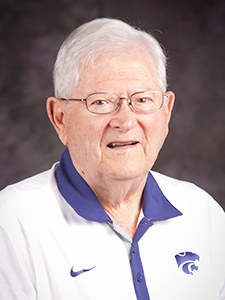
MANHATTAN — For generations of Wildcats and Manhattan residents, C. Clyde Jones was more than a university leader — he was a symbol of service, optimism and deep-rooted commitment to the place he chose to call home. Known throughout town as "Mr. Manhattan," Jones lived to 102 and spent more than six decades strengthening Kansas State University and the surrounding community he loved.
Born in Huntington, West Virginia, in 1922, Jones spent his early years along the Ohio River before joining the U.S. Navy during World War II. After serving in the North Pacific, he began building a career in higher education. His early academic appointments took him from Northwestern University to Georgia State University and the University of Illinois — a path that ultimately led him to Manhattan in 1960 to become the first dean of K-State's College of Business Administration.That move set the course for the rest of his life.
In his role as the inaugural dean, Jones established programs, recruited faculty and built the foundation for what would become one of the university's signature colleges. His leadership helped define business education at K-State during a period of rapid growth, positioning the college as a destination for students across Kansas and beyond. Jones kept a close relationship with the College of Business faculty, staff and students. "He cut the dedication ribbon when we opened the new Business College building in 2016, we hosted his 100th birthday party in the atrium of the Business College, and we dedicated the C. Clyde Jones Executive Lounge on the fourth floor of the building to honor his work at K-State and in the community," said Kevin Gwinner, Edgerley Family Dean of the College of Business Administration. "
For the past decade, he has come back each semester as a guest lecturer in our business classes. His primary message to the students was the importance of being concerned with the welfare of others by showing compassion and empathy. He would implore the students to meet someone new every day. His mark on the college, university and community will be felt for generations."In addition to his leadership in the business college, Jones served K-State as vice president for university development from 1966 to 1970 and chaired the University Athletic Council from 1965 to 1975. In that role, he played a key part in designing and securing funding for what became a 34,000-seat football stadium — a transformational project that shaped the trajectory of K-State Athletics for decades.
"C. Clyde Jones left a legacy on this campus few can compare with," said Adam Walker, president and CEO of the K-State Alumni Association. "The College of Business Administration is the most obvious example. He helped build that program, serving as the college's first dean. As chairman of the University Athletic Council, he helped lay the groundwork and raised the funds for KSU Stadium, which we now enjoy as Bill Snyder Family Stadium. In the community, he helped many people through his charitable work, especially with Shepherd's Crossing. But his greatest legacy are the countless K-Staters he taught in the classroom, many of whom today are still using the lessons he taught them."
Jones retired from the university in 1987, but retirement did little to slow him down. In many ways, the years that followed demonstrated the fullest expression of his belief in service, community and connection. The most far-reaching example occurred in 2001, when he joined local faith leaders in establishing Shepherd's Crossing—a nonprofit that provides financial assistance and budgeting guidance to families in need.
According to Ann Knackendoffel, president of the Shepherd's Crossing board, Jones' leadership was essential from the beginning. "C. Clyde played a key role in founding Shepherd's Crossing," she said. "A group of churches united to better coordinate efforts to meet the growing financial needs of families in our communities. Both C. Clyde and Rev. Jim Reed were essential in establishing Shepherd's Crossing 25 years ago. They had a vision and provided the leadership needed to launch the organization."
Knackendoffel said the scale of the organization's reach today reflects Jones' early determination to create something built to last. "In the beginning, we were providing about $4,000 a year in assistance; today, that amount is over $400,000," she said.
Jones embodied the shared spirit of service that defines both K-State and the Manhattan community. "K-State promotes the idea of family. As a member of the Manhattan community for 40 years, I have seen that clearly in our community as well. C. Clyde had both feet firmly planted in K-State and the Manhattan community," she said. "When he saw a problem or a need, he never backed away or said, 'that is too big of an issue,' nor did he ever say, 'that's someone else's problem to solve.' He didn't see a line between the university and the larger community and never separated the two."Jones also poured his energy into community events that brought people together for a cause. He created the C. Clyde Run and later Midge's Mile — named for his wife, Margaret "Midge" Jones — as annual fundraisers for Shepherd's Crossing. The events became traditions that reflected the warm, joyful spirit of the couple and the values they lived by.His ability to build relationships across generations was one of his greatest gifts.
Knackendoffel recalled meeting Jones and his wife early in her time in Manhattan — a moment that marked the beginning of a lifelong friendship."C. Clyde had a knack for finding people and getting them involved," Knackendoffel said. "He continued serving on the Shepherd's Crossing board well into his 90s, submitting grant proposals on our behalf, and challenging us as an organization to do more. His presence will be greatly missed."
A memorial service celebrating his life will be held at 3 p.m. Saturday, Nov. 15 at First United Methodist Church on Poyntz Avenue. The C. Clyde Jones Memorial Fund through the KSU Foundation celebrates his impact and supports future Wildcats who share his passion for learning and community. Throughout his long life, Jones approached his work with humility and gratitude. As Manhattan and K-State gather to honor him, Jones' legacy lives on in the institutions he strengthened, the community he cherished and the countless people he lifted along the way. His example endures as a reminder that leadership rooted in kindness, service and commitment can shape not only a university, but an entire community.