


For the last decade, I have lived, studied, worked, and raised my family in Manhattan. Though it may have been the US Army that brought my family to the Flint Hills, Manhattan is where my family and I have chosen to settle down now that my husband has retired from the Army. I grew up in the San Francisco Bay Area and have lived overseas in both South Korea and Germany, as well as on the East Coast in Savannah, Georgia and Williamsburg, Virginia.
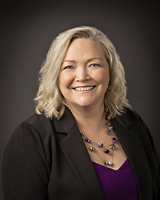
I earned my Bachelor of Arts in Political Science and Master’s in Public Administration while studying at Kansas State University and I am currently pursuing my doctorate in Leadership Communications. In addition to my role as a student, I have been working as an assistant graduate program coordinator and administrative assistant in the Grain Science and Industry department for the last three years.
During my master’s program I completed two summer internships with the City of Manhattan. I was responsible for developing and presenting supervisor training sessions concerning hiring guidelines and laws and performance evaluation best practices, as well as other projects.
Since filing for your consideration as a Commission Candidate in April, I have attended 22 of the 26 City Commission meetings. I have also knocked on over 500 doors and had the privilege of meeting, listening to, and learning from many community members and groups.
This summer I worked with other PhD students in my program to develop a community outreach program for Reno County to survey community spending priorities associated with the federally disbursed American Rescue Plan funds.
My experiences compel me to work towards making Manhattan the best it can be.
Why should I vote for you?
I am passionate about public service and promoting civic engagement in Manhattan. I want to use the knowledge and skills I have gained at K-State, on the job and in my life experiences to help make positive change happen in our community. I want to help Manhattan grow in responsible and sustainable ways. Manhattan has afforded my family many wonderful opportunities, and I want all residents to feel like they have access to opportunities that make their lives better here as well. Manhattan has excellent schools, a truly innovative business community, and a vibrant social life; yet too many residents are transitory because we have not yet explored all the ways to keep talented workers here. A crucial aspect of retaining talent in a town like Manhattan is making sure there are well-paying jobs and supportive services for people at all levels of educational attainment who want to stay in Manhattan. I will work with citizens and community stakeholders to find innovative solutions to develop and attract more diverse business opportunities in the community. While Manhattan has a lot of good things going for it, I believe there are still many things we can do to make this community a stronger and more vibrant place to live.
What is your biggest budget priority and why?
Fiscal Responsibility--Taxes should not be raised without exploring all possible revenue or cost-savings options or without carefully weighing the service or need the proposed tax will fill. The City has realized less revenue from sales tax and fees than was budgeted for the past 6 years. The City should focus on why budgeted revenue projections continue to be set at unattained levels, instead of stressing property taxes increases are the stable and sustainable solution, the City needs to plan its expenditures based upon attainable revenue projections.
The City Commission can work to balance the needs of the City government without overburdening taxpayers by:
Expanding our tax base by supporting economic development initiatives that attract more people to come, play, and stay in Manhattan.
Requiring annual budget proposals to be presented with a detailed breakdown of the services that will be provided and cut at each level (percentage or mill levy points) of proposed funding increases. This will help to ensure informed and transparent funding decisions.
Ensuring funds are only spent on the programs or departments to which they are allocated. Too often funds from the City’s Economic Development Fund and Water, Wastewater, Stormwater Fund have been used to fund other operations. Our community has serious infrastructure needs and previous water rate increases were relayed to the public as necessary measurements to fund plant upgrades, sewer improvements, and to fund storm water CIP projects. Using these funds to subsidize other operations demonstrates a lack of transparency or fiscal responsibility.
Requiring the City to present a 5-year City Capital Improvement Program plan, to include funding source information for each project, on an annual basis.
Requiring the City to include annual operational cost projections on any project proposal.
How would you draw more economic development and investment to Manhattan?
The City Commission can foster economic development by courting businesses that both complement and expand our existing commercial base. One way to do this is to focus on providing incentives for companies to construct spec buildings that would attract firms related to research and development, engineering, manufacturing, animal science or agriculture technology, as well as information technology, or software development.
Economic Development incentives are a tool to create new jobs. The City must offer a high quality of life to attract more business and commerce to Manhattan. The City Commission must provide well-maintained, modern infrastructure to attract new investment. The Commission must also work with community partners to ensure the supply of safe and affordable housing to support relocation and other start-up needs.
Over 60% of Manhattan residents are renters and many community members have expressed their struggles with finding safe and affordable rental housing, which negatively influences their desire to either stay in, or return to, our community.The City Commission can help address the housing situation by passing a rental inspection program that includes both mandatory licensing and inspections as elements of the program. The program would enforce critical minimum standards that would serve to protect the safety, health, and general welfare of all persons occupying rental properties within the City of Manhattan.
Manhattan also needs more affordable childcare options to meet needs of our workforce. The City should look at options that would build the supply of childcare, such as the use of federal Community Development Block Grants (CDBG) to build new childcare facilities and ensuring local zoning regulations do not make it difficult or impossible for residents to provide family childcare services in their homes.
Plans like these would present potential businesses with solid reasons to invest in Manhattan and become long-lasting partners within our community.
What does Manhattan do well? How should that be maintained/expanded?
The pandemic exacerbated existing inequities and brought to light other unnoticed/unaddressed inequities. However, the pandemic also brought attention to the multitude of community groups that are working hard every day to meet the various social service needs within our community. There are a lot of caring people in this community and often times it is the various community groups that step up to fill in the gaps created by inequities. Myself, I helped with the preparations and execution of a community event that gave away 15,000 pounds of free flour to the community and coordinated another effort recently that provided 2,500 pounds of flour to various K-12 schools throughout the state of Kansas.
While we are fortunate that there are many churches, community groups, and concerned citizens within our community who are willing to step up, our local governance needs to step up too. The City Commission and the City Administration need to stop trying to implement one-size fits all solutions, because quite frankly they hardly fit the needs of the various neighborhoods well.
What future improvements/additions/changes should be prioritized?
We are a river city, yet we have turned our backs on the opportunities that our rivers offer us. Responsible and sustainable development of our riverfront is imperative. This is essential not only to the economic development of our city, but the modernization and mitigation of the potential devastation from the Big Blue, Kansas River, and Downtown East Watersheds. There are currently 767 structures at risk of flooding in this city. Headwaters Economics – a nonprofit land conservation and community development consultancy – estimates over $87 million in damages to homes and businesses in the event of a 100-year flood as the city faced in 1951, 1993, and 2015 and even more costly should Manhattan experience a rainfall that caused the flooding in 2018. For every dollar the City invests in flood mitigation, the City can save up to $7 dollars in repair costs related to flood damages.
The loss of Country Stampede to flooding concerns hurt our sales tax base; however, a riverfront development would offer a premier open-air space that could attract other festivals or performances. The riverfront area would also provide for walking and biking trails, kayaking, city markets and outdoor entertainment. Furthermore, if we develop our riverfront to connect to with the Downtown area it would support and enhance the economic development efforts in that district as well. This type of development would set us apart from other communities in Eastern Kansas.
In what ways, if any, does Manhattan need to adapt for the mass influx of families for NBAF and Afghan resettlement?
To adapt for the influx of families for NBAF, we need to look for ways that will attract firms related to research and development, engineering, animal science or agriculture technology. We need to incentive development firms to build more research lab spaces. This will work to enhance of community partnerships with both NBAF and K-State.
To help the Afghan resettlement effort we need to coordinate with our community partners such as K-State, USD 383, and our vast multitude of social services agencies and faith communities to pool our available resources to address such needs as housing, language education, and employment opportunities.
What ways, if any, should the concepts of diversity, equity, and inclusion be included in professional development or other training for City employees?
I helped to develop some of the City’s employee training on the City’s non-discrimination policy, as well as supervisor training on hiring guidelines and laws, and best practices related to annal performance evaluations. It is imperative for City employees to understand the inherent value of each member of our community. The work of the City is to provide services for the people, it therefore stands to reason that City employees should appreciate that everyone has various talents, skills, and abilities and we are made stronger by respecting each other and seeking to include all segments of our population in our discussions, plans, and community efforts.
What is your top, specific issue in running for this office and why?
First and foremost, I am concerned with good governance. I believe the role of an elected representative is to conduct all the business of the people transparently. Transparency is more than a buzzword; it means being willing to discuss all the issues and opportunities confronting our community in public spaces. Transparency is a core element of accountability. Any candidate who asks for your vote, should be willing to dedicate the time necessary perform the job well. No commissioner should be willing to pass the buck on decisions that affect our community. Moreover, they should not be more concerned with their reelection, than your needs. Failing to meet community expectations, repeatedly showing up late, or not at all, show a lack of consideration for you and the work at hand.
I will always vote to discuss issues raised in work sessions in front of the public. Furthermore, I will always ask for all tax or budget proposals to include a detailed listing of the services that will be funded (or cut) at all requested funding levels. This would help residents understand where their monies are being spent and what services will be expanded, maintained, or cut.
I want some of the commission meetings to be held in our various community centers throughout the city in order to be more inclusive and accessible.
Editor’s Note: All candidates were provided identical questions. All candidates were given identical time limits for response submissions. Responses were limited to 300 words per question. Candidate responses are published as written, up to 300 words. Only candidates choosing to respond will be profiled.