


By GLORIA FREELAND
Courtesy Kansas Reflector
As fellow history buffs, Cheryl Collins and I hit it off immediately.
I don’t remember when we first met, but it was probably at the celebration of some historical event. Perhaps it was at a McCain Auditorium performance, since her husband, Gary Clift, is a theater and arts critic for the local paper. I’ve seen her at least monthly the past few years because I am a Riley County Historical Society board member.
I always counted on Cheryl and her staff to help me with research on various writing projects. When I taught a news writing course at Kansas State University, I asked her if my students could tour the museum and the nearby home of settlers Isaac and Ellen Goodnow.
Cheryl eagerly agreed, pointing out various details about the walls, shelves and floors that gave “clues” as to what the original home looked like when the Goodnows lived there. She shared copies of early county newspapers and mentioned how much historians depend on journalists to help piece together local stories of people and places.

But I won’t be able to call on her expertise any more. Cheryl died in September at age 68, after a brief illness. Her death hit me particularly hard as it was unexpected and she was always so full of life. Her passing caused me to reflect on some of the many projects she was involved in.
In 2005, she and her staff helped plan the sesquicentennial celebration of Manhattan and Riley County. She helped arrange school bus tours of various historical sites. Husband Art, mom and I joined, visiting county ghost towns, the stone arch bridge in nearby Bala Park, rural schools and several churches.
Cheryl said: “I think we have as much history inside the bus as we’re seeing on the outside.”
The 45 people ranged in age from the 20-something bus driver to a 100-year-old woman who had lived in the county since 1928.
My Community Media class collaborated with area students on “Riley County Legacy,” a special section inserted into the Riley Countian and K-State Collegian newspapers. The section included stories about cemeteries, churches, schools, ethnic groups, farming, businesses, and more, to illustrate the history of small communities in the county. Cheryl was excited about the project, telling my students, “Your stories are important, but they will be even more important 100 years from now.”
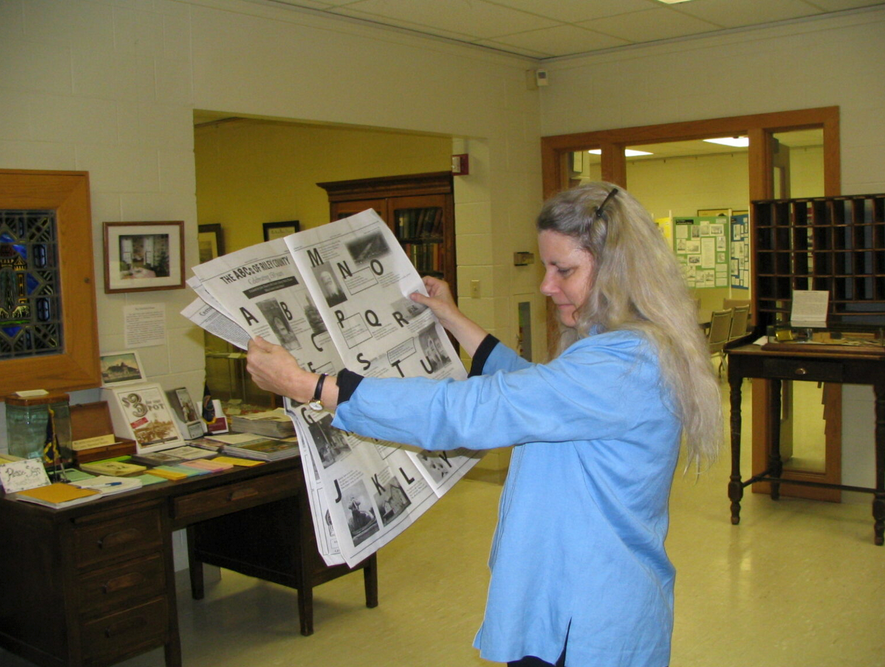
Cheryl’s service to the Riley County Historical Museum spanned more than 40 years. She began as an intern, was hired by the county in 1981 and then became director in 1988, being chosen over nearly 50 others.
Some historians get stuck in the past, but Cheryl wasn’t one of those. She encouraged people to preserve their own stories. One of her latest projects was to ask people to write down their impressions of life during the COVID-19 pandemic and to save photos and artifacts so future generations can understand what life was like during this time.
She collaborated with other organizations in the county to design programs to make history exciting for all ages. An annual event was the fourth-grade class tours of the native limestone Wolf House Museum to learn what life was like in 1880s Manhattan.
In spring 2018, a three-part series, “Time Travel to the 1880s,” was geared toward older folks. One of the lectures — “The Glitter and the Gloom” — included more than just a slideshow of old black-and-white photos. Museum staff members passed around small bottles of Mentholatum and asafoetida, popular home remedies of the era. Tea was served with biscuits, the latter made from an updated version of a personal recipe of Nellie Sawyer Kedzie, a domestic science professor at Kansas State Agricultural College (now K-State) in the late 1800s.
Cheryl liked the story about the Hartford steamboat. It left Cincinnati on April 26, 1855, with settlers planning to start a town in Kansas named Manhattan. It ran aground near the new village of Boston. The Hartford passengers joined their town after it was agreed to change the name to Manhattan.
On April 9, 2015, Cheryl donned gloves and picked up a rubber hammer to ring the Hartford’s bell, which is mounted in the museum lobby. The occasion was the 150th anniversary of Confederate Gen. Robert E. Lee’s surrender to Union Gen. Ulysses S. Grant. Cheryl did so for four minutes: one minute for each year the war raged.
I laughed when she later told me, “Four minutes is longer than one thinks!”
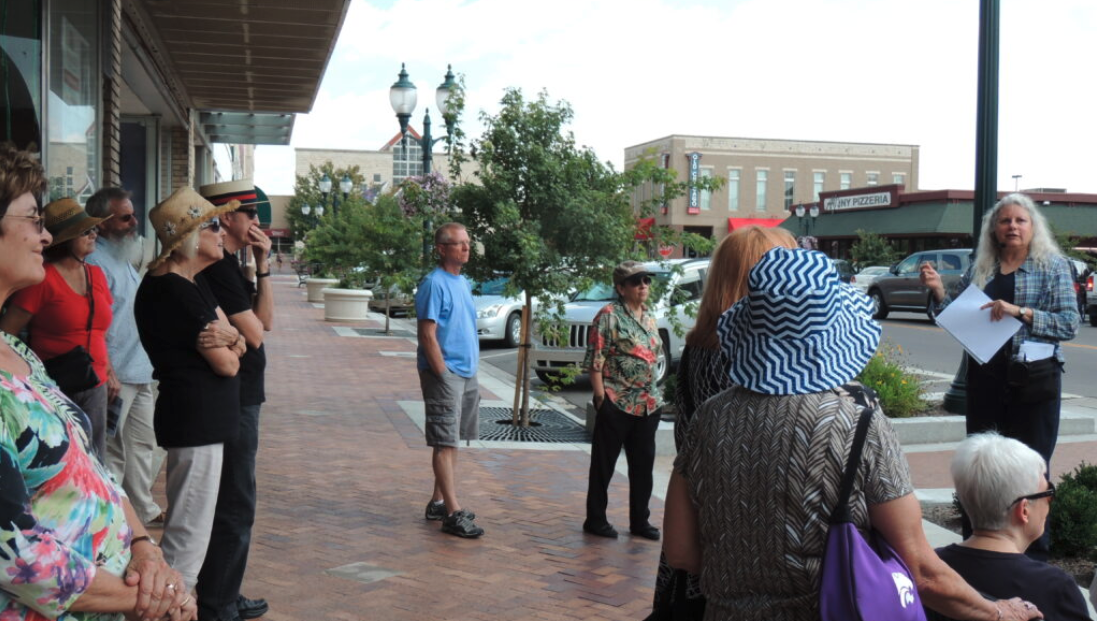
She led walking tours of Manhattan’s downtown as well as Sunset Cemetery, where she spoke about various buildings and characters important to the area’s history. These were ways Cheryl made the past “come alive.”
Jean Folkerts Towns, a former RCHS board member, remembered what a hard worker Cheryl was.
She had a true nonprofit spirit. When the historical society benefited from the will of a person living in Texas, she drove to Texas and personally helped clean out the person’s house and get it ready to sell. She always had the long term financial stability of the society at heart.
Ned Seaton, publisher of the local newspaper, said in an editorial that Cheryl was “a true gem in our community.”
She made local history relevant and interesting, and in fact, vital. It wasn’t that she asserted herself in contemporary political debates with random historical facts. It’s that she managed to convey how fascinating our collective past here really is … We at the Mercury felt particularly close to her because of that enthusiasm, and because we relied on her knowledge to help us connect our current stories to their deeper roots.
Linda Glasgow, museum curator archivist and librarian, said the staff was sad, but are carrying on Cheryl’s legacy. “Cheryl was our boss, but also our sister,” she said.
That says it well. Yes, she was a historian, a collaborator and a contemporary. But more than that, my history sister was a friend. I miss her.
Gloria Freeland, K-State emeritus professor of journalism and mass communications, is a member of the Riley County Historical Society. She often writes about historical topics and she has been writing a weekly column, “Kansas Snapshots,” for almost 20 years. Her current and past columns are available at www.kansassnapshots.com.