


By Jeanne Kuang and Nigel Duara
CalMatters
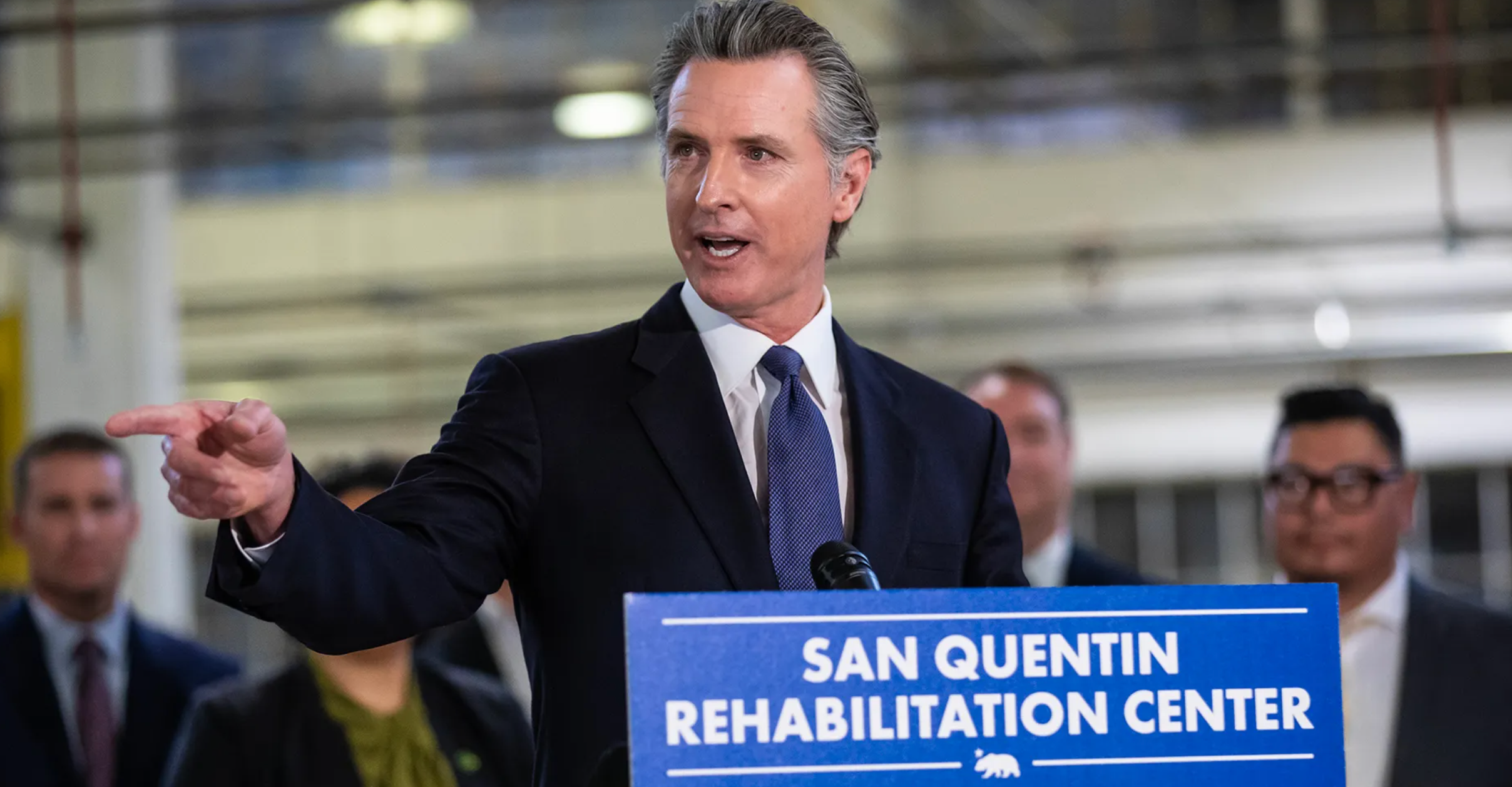
Gov. Gavin Newsom commuted death sentences for 548 state prisoners, saying “state-sanctioned killing is incompatible with California’s values.” Victims rights advocates criticized his decision.
Gov. Gavin Newsom is commuting the death sentences of 548 people, clearing the California death row for the first time since the state conducted hangings in the late 19th century.
It is a monumental move in the history of capital punishment in America: The prisoners represent more than a quarter of the nation’s condemned inmates.
And it is a decision Newsom, a longtime opponent of the death penalty, has spoken about in starkly personal terms. In 2019, shortly after taking office, he issued a moratorium on executions and then dismantled the execution chamber in San Quentin State Prison. It was just three years after voters rejected a ballot measure to abolish the death penalty and instead approved one to speed them up. At the time, the governor said he couldn’t be responsible for killing another person.
“After nearly 30 years in office I have come to understand the limits of what government can justly accomplish,” Newsom wrote in a Thursday letter addressed “to all Californians.” “I take this action because I firmly believe that state-sanctioned killing is incompatible with California’s values, undermines the foundations of our legal system, and diminishes each of us.”
His anticipated decision garnered sharp condemnation in recent weeks from victims’ groups, who argued it flew in the face of juries and judges that had upheld the death sentences, and voters who have upheld the practice.
“I don’t think he or any person should undo the sentence rendered by a jury and signed off by a judge because of his personal beliefs or feelings,” said Topo Padilla, president of Crime Victims United, last week.
Since 2024, death row has been a metaphorical place. The male prisoners were cleared out of their individual cells in San Quentin and distributed among other 24 facilities. Twenty female prisoners condemned to death were moved to general population at the Central California Women’s Facility that year.

Even before Newsom’s 2019 moratorium, it had been more than a decade since the state performed an execution. His successor, Gov.-elect Xavier Becerra, has committed to extending the moratorium when he takes office. But a recent botched execution attempt in Tennessee and the Trump administration’s suggestion of televised executions has thrown the country into a renewed national debate over capital punishment.
It is not unusual for governors or presidents to commute sentences on their way out of office. Then-President Joe Biden commuted the sentences of 37 of the 40 federal death row prisoners in 2024. Newsom’s decision stands out as the largest act of mass clemency in U.S. history, according to the Death Penalty Information Center.
It comes as he decides whether to run for president after his term ends at the end of the year. Along with other signature Newsom moves like his early recognition of same-sex marriages as San Francisco mayor in 2004, it could boost his standing among Democrats as a bold actor pushing forward liberal causes, while inviting criticism from the center and right and from tougher-on-crime advocates.
Already, anti-death penalty groups have released an ad invoking Martin Luther King, Jr. that praises Newsom’s move as “rooted in justice, guided by conscience and made with courage.” Dan Newman, a Democratic strategist who works with those groups and also advises Newsom, said the governor made his decision without his political team and that Newsom did not know about the ad.
Most of the decisions Newsom made Thursday will need court approval. For those convicted of multiple felonies — nearly 400 prisoners — four of seven judges on the California Supreme Court will have to sign off on the commutations.
Anne Marie Schubert, chief executive of the Criminal Justice Legal Foundation and a former prosecutor, pledged that her group would challenge Newsom’s proposed commutations in the state Supreme Court. She said victims’ families were not notified of the proposed commutations.
“I find it atrocious and disrespectful and the most grotesque violation of victims’ rights I’ve ever seen,” Schubert said. “There’s 548 people on death row. That’s no less than 548 families that have been destroyed by what these people have done to their loved ones.”
Newsom said those with the commuted sentences will not be eligible for new Board of Parole Hearings commutation and resentencing regulations. That addresses some concerns prosecutors, victims’ groups and supporters of the death penalty had expressed as they anticipated Newsom’s decision: that those newly sentenced to life might get a chance later to be released.
“These offenders will die in prison but not by our hand,” Newsom wrote.
He said in his letter that the decision is among the most difficult of his career, “not because I doubt its necessity for our state but because I know its announcement may surface excruciating memories for victims’ families.” He said after meeting with them over the years, he considered commuting only some sentences but “that attempting to distinguish among crimes and offenders for clemency would inadvertently create two classes of murder victims — those whose perpetrators deserve the death penalty and then the rest.”
Last execution in 2006
California has not executed a prisoner since Arnold Schwarzenegger was governor. Tookie Williams in 2005 and Clarence Ray Allen in 2006 were the last to die by execution at San Quentin.
Newsom inherited a very different prison system than Schwarzenegger’s, marked by a rapidly decreasing incarcerated population. He moved to close five prisons so far, including a facility in Norco that was shut in October, and refashioned San Quentin as a hub for rehabilitation.
Natasha Minsker, former director of the American Civil Liberties Union of California’s Center for Advocacy and Policy, said the death penalty is now a forgotten part of California politics. “I’m shocked, when I talk to legislators and tell them to oppose it, they say we don’t have the death penalty in California,” she said.
Mary McComb, the former state public defender, said from her first case defending a man with intellectual disabilities who was charged with a capital offense, she has found a moral reason to oppose the death penalty.
“One can always hope, but without the commutations, it’s not always guaranteed that governors would continue to have the courage to (maintain a moratorium),” McComb said.