


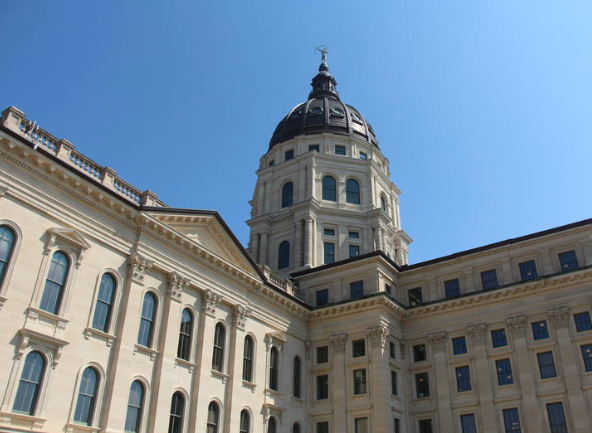
Senate, House convene to consider vetoes and potential deal on property taxes
By: Tim Carpenter
Kansas Reflector
TOPEKA — The Republican-led Kansas Legislature reconvened Thursday to weigh Gov. Laura Kelly’s veto of two dozen separate bills and line-item vetoes of more than 30 provisions in a state budget bill the Democratic governor viewed as unconstitutional, unethical or unreasonable.
Kelly signed House Bill 2513 after relying on her executive authority to delete from the budget a 4.4% pay raise for state legislators, the 1.5% across-the-board cut to selected state agencies, a “sweetheart” $50 million taxpayer-backed loan to Yingling Aviation of Wichita and the no-bid contract with Motorola for an emergency communications system that could cost $100 million.
On Wednesday, she said the state budget ought to reflect values of Kansans from every corner of the state and should represent meaningful collaboration between a governor and legislators.
“The Legislature has abandoned that partnership,” Kelly said. “Despite this being a really bad budget, I will sign it, because the alternative is worse. This is the last budget that I will sign as governor. It is my hope that the next governor will have a Legislature that is willing to return to the traditional partnership that is more likely to produce a budget that is fiscally responsible, invests in our state’s future wisely and is befitting the trust Kansans place in us to be good stewards of their resources.”
Kansas House Speaker Dan Hawkins, a Wichita Republican running for state insurance commissioner, said during a forum in Topeka that he anticipated Kelly would use executive power to veto pieces of the budget. He said some adjustments by the governor could be useful, if they curtailed expenditures.
“She will line-item veto some things and hopefully save us more money,” Hawkins said. “Probably one of my biggest disappointments is how hard it is to get our folks to understand that your expenses need to equal your revenue. It’s really tough. It’s a steady flow of people wanting money, and it’s hard to say no.”
Documents released by the Legislature indicated the budget forwarded to the governor would spend more in the fiscal year starting July 1 than analysts expected the state to receive in annual revenue. One estimate put overspending next fiscal year at $475 million, which would be an improvement from the current fiscal year. In this year’s budget, the state was expected to spend $705 million more than revenue deposits. For the past three years, the state has relied on cash reserves to cover structural deficits.
Historically, the Legislature hasn’t adjourned the session before fiscal analysts met in late April to revise income and sales tax revenue projections for the upcoming fiscal year. That meeting won’t occur until April 20.
Long list of budget vetoes
It’s unclear which of the 31 line-item budget vetoes leadership of the House and Senate would attempt to override by leveraging Republican supermajorities in both chambers.
Kelly deleted state funding to unregulated pregnancy crisis centers that urged women to avoid abortion, rejected an “irresponsible” provision guaranteeing legislators special privileges when using parking lots and rebuffed the narrowing of vaccination mandates for school children.
“Making abrupt changes to these longstanding vaccine schedules erodes trust in scientific evidence and the safety and efficacy of vaccines, ultimately endangering the health of Kansans and our communities,” the governor said.
Kelly vetoed part of the budget allowing the House speaker and Senate president to hire staff who would have access to sensitive personal information, including bank account details and Social Security numbers, on every state employee and all persons or entities receiving state funding in the past 10 years. The Legislature wanted these political appointees to search for government waste and fraud, but the governor said the Kansas Department of Administration hosted a publicly available database on financial transactions that didn’t expose sensitive personal information.
“I would urge lawmakers interested in reviewing this data to make use of the publicly available resources already in place rather than attempting to circumvent privacy rules for their own political games,” Kelly said.
Kelly vetoed from the budget a section deleting $6 million of the $16 million allocated by the Kansas Department of Aging and Disability Services for mental health intervention teams in public schools. The proviso would have left in place all $1.5 million earmarked for mental health interventions in private schools.
The governor said the Legislature ought to have determined if there was research to support “this ill-informed reduction” in mental health aid. If the program must be cut, the governor said, reductions at public and private schools should be proportionate.
In addition, Kelly vetoed sections of the budget altering standardized testing of K-12 students. She said the changes would have violated mandates in the Kansas Constitution directing the elected Kansas State Board of Education, rather than the Legislature, to maintain oversight of public schools in the state.
The governor rejected language in the budget that interfered with First Amendment rights of students enrolled at public schools. The proviso would financially penalize school districts and sanction students who left school property to participate in a protest during classroom hours.
Kelly also vetoed a clause preventing the Kansas Department of Health and Environment and the Kansas Department for Children and Families from spending money to comply with federal law requiring that applicants or recipients of public assistance be given an opportunity to register to vote. The 10th Circuit U.S. Court of Appeals, which covers Kansas, has held applicants not responding to a voter registration question on an application must be sent a registration form by the relevant agency, such as KDHE and DCF.
“The Legislature is once again ordering my administration to ignore federal law and will almost certainly force the state into costly litigation,” Kelly said.
In the 2025 legislative session, Kelly issued a comparable number of line-item budget vetoes. The Legislature overrode her on half of them.
Two-dozen vetoed bills
The Legislature’s GOP leadership — Hawkins and Senate President Ty Masterson of Andover — must decide which of the 24 freshly vetoed bills they would attempt to override.
Kelly vetoed bills restricting voter registration and mail-in balloting, limiting the right of reporters to observe law enforcement activities, and restricting the ability of cities or counties to make independent decisions on litigation. She also vetoed bills expanding access to public funding for private schools and repealing a state law granting in-state university and college tuition rates to qualified students brought to the United States as children.
Masterson, who is a candidate for the GOP nomination for governor, said Kelly made a mistake vetoing Senate Bill 254, which blocked taxpayer benefits to anyone in the United States without government permission.
“Laura Kelly has prioritized illegal aliens over Kansans,” Masterson said. “She chose to send your hard-earned tax dollars to benefit illegal immigrants, not Kansas families. I can ensure the people of Kansas that when I’m governor, taxpayer-funded handouts for illegals will come grinding to a halt.”
While bills in Kansas pass the Legislature on simple majority votes of the Senate and House, veto overrides of a Kansas governor required two-thirds majorities in both chambers.
The Republican leadership also was expected to focus during the wrap-up portion of the annual session on its commitment to deliver property tax relief to Kansans. Before temporarily adjourning last week, the House defeated a Senate-passed constitutional amendment that advocates thought could curtail property tax spikes.
The urgency for the Legislature to act on property taxes was compounded by the governor’s decision to veto House Bill 2745, which she argued would inappropriately disrupt flow of revenue relied on by cities, counties and school districts to meet the needs of constituents they served.
“Kansans deserve real property tax relief, and they deserve the truth about how such relief can be accomplished,” Kelly said.