


BY: GRACE HILLS
Kansas Reflector
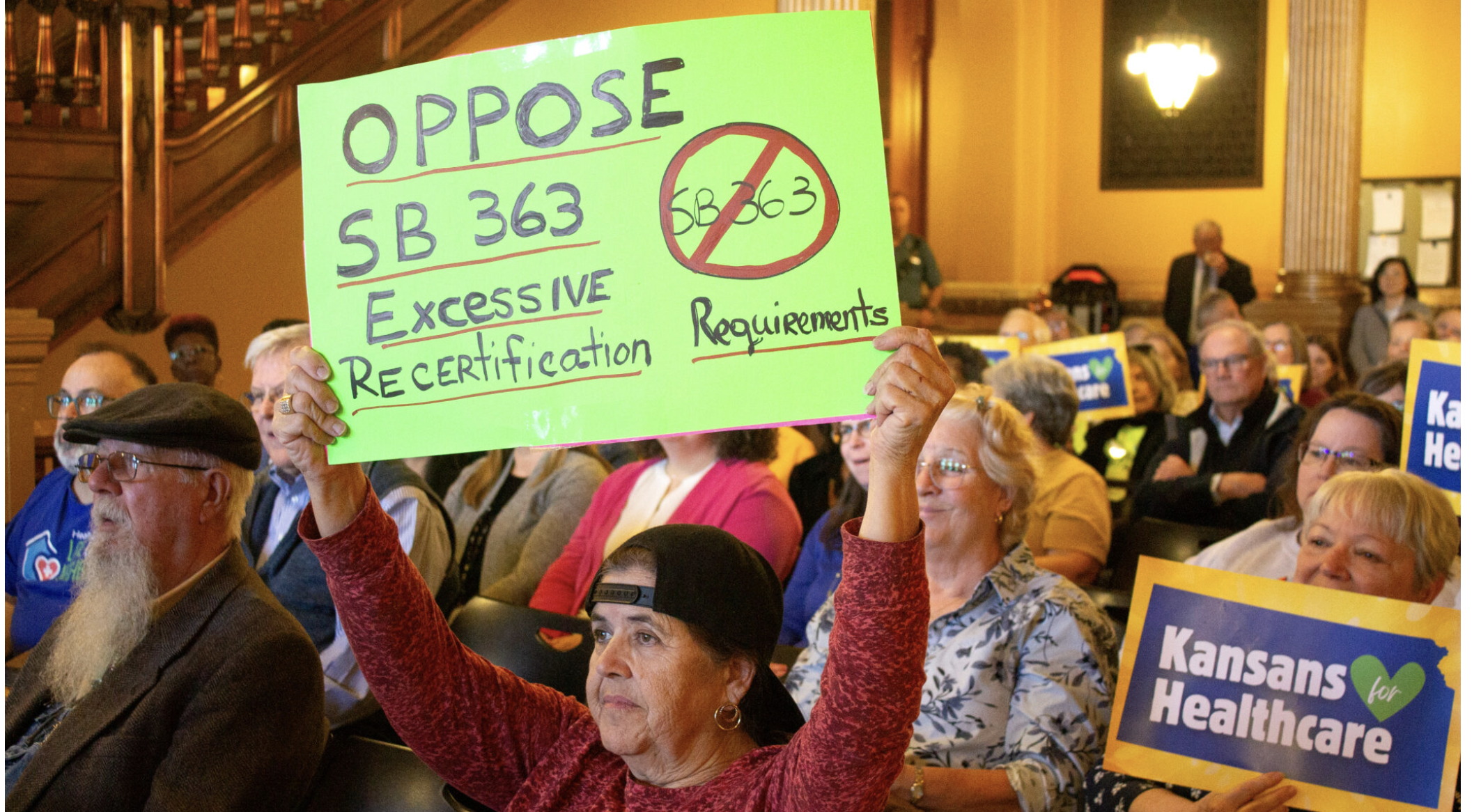
TOPEKA — Advocates, medical providers and recipients of public assistance programs rallied Thursday at the Statehouse with a clear message: restricting access to these programs would hurt Kansans.
Senate Bill 363 imposes a sweeping set of steps to verify Kansans’ eligibility for the state’s medical and food assistance programs. April Holman, executive director for Alliance for a Healthy Kansas, said opponents disapprove of the whole bill, but have stronger concerns for two elements.
The first is eliminating self-attestation. That means applicants no longer could self-attest their income, residency, age, household composition, caretaker relative status or other coverage. State agencies would have to verify those claims.
Income and residency are already verified by state agencies, but Holman said the bill would ask the agencies to verify things like household size, which she said are difficult to identify.
“The first is the self-attestation, the prohibition,” Holman said. “The second tends to be the thing that we are most concerned about.”
The second thing is the quarterly redetermination process, a switch-up from the current one-year reapplication.
“We know that all of the people who are in the Medicaid program in Kansas, because we don’t have expansion, tend to be very vulnerable,” Holman said. “They are people who have a disability that’s been determined by the Social Security Administration. So it’s very difficult to get determination.”
Amendments to the bill would exempt pregnant people, seniors, those younger than 19 years old, and those on home and community-based service waivers from the quarterly redetermination.
The bill still applies to people with mental illness.
Angela Watson, a mental health provider from Wichita who spoke at the rally, said she is a Medicaid success story. She was on Medicaid for 13 years.
“This proposal to move Medicaid eligibility checks to quarterly redeterminations may sound like a single administrative change,” Watson said. “For people living with serious mental illness, it has the potential to create very harmful consequences.”
She said the red tape of managing paperwork can be difficult for people with severe depression, anxiety, trauma, psychosis or delusions.
“Changing this process to every three months means quadrupling the chances that someone will lose coverage simply because a form was missed, a letter arrived late, or a document wasn’t submitted in time,” Watson said.
“This doesn’t mean they’re no longer eligible. It means they got lost in the system,” she added. “And when people lose Medicaid coverage, even temporarily, the consequences are immediate. Mental health treatment depends on continuity of care.”
Kari Rinker, who represents the American Heart Association, said she has a masters degree and has spent years navigating paperwork. She helped her son fill out the public assistance programs’ paperwork after he suffered a life-altering car crash.
“I found myself overwhelmed,” Rinker said. “It is complex. We would receive paperwork well past deadlines and feel abject panic.”
Her son would be subject to the quarterly redeterminations.
After the rally, opponents of the bill flooded Thursday’s House Welfare Reform Committee.
Committee conversations
Along with ending self-attestation and implementing quarterly redeterminations, the bill would:
- Cross-check eligibility data across state agencies on a rolling basis. The state would check sources from various offices and departments to search death records, employment and wage changes, income and residency changes, and incarceration status. Out-of-state Electronic Benefits Transfer transactions would be monitored as a signal that a recipient may have moved out of the state. Lottery and gambling winnings of $3,000 or more would also trigger a review.
- Share Medicaid enrollment data with federal offices. The Kansas Department of Health and Environment would submit medical assistance enrollment data monthly to the Centers for Medicare and Medicaid Services to remove anyone enrolled in Medicaid in multiple states.
The process would cost the state an estimated $17 million. Republicans in both the Senate and House raised their eyebrows at that.
The Florida-based FGA Action, the lobbying arm of the conservative Foundation for Government Accountability, which is dedicated to limiting government benefits, brought forward the sole two proponents of the bill — who said it would eventually pay for itself. They also said it would bring Kansas in step with President Donald Trump’s One Big Beautiful Bill Act.
“That’s not the case,” Holman said.
Holman said federal law would control what happens in Kansas regardless of if it is codified in Kansas law. But she said there are two elements of the bill that go beyond federal law that would hurt both Kansans on public assistance programs and the departments that administer those.
In an interview, vice chair of the House committee Rep. Dale Helwig, a Republican from Columbus, said he believes the bill brings Kansas into compliance with the One Big Beautiful Bill Act, which is also called H.R. 1.
“There are some things that probably are a little more restrictive than H.R. 1, which we need to work through, but I think we will. We do need to get rid of the self attestation on some of this stuff,” Helwig said.
He pointed to the recent state audit that estimated Kansas subsidized a jarring amount of free-and-reduced lunches that shouldn’t have been.
Rep. Clarke Sanders, a Republican from Salina also on the House Welfare Reform Committee, said he isn’t a fan of self-attestation either.
“The problem, of course, is that’s gonna take more people to get that done. And we probably don’t have enough as it is now,” Sanders said in an interview.
Both are apprehensive about the quarterly redetermination process for different reasons. Helwig said it could be more efficient — there was a five-minute long conversation during the committee about state agencies’ use of fax machines.
Sanders thinks redetermination once a year is enough. He thinks there will be amendments proposed when the committee works the bill.
“I think once those get on, I’ll be able to support it,” Sanders said.
The bill passed the Senate 25-12.