


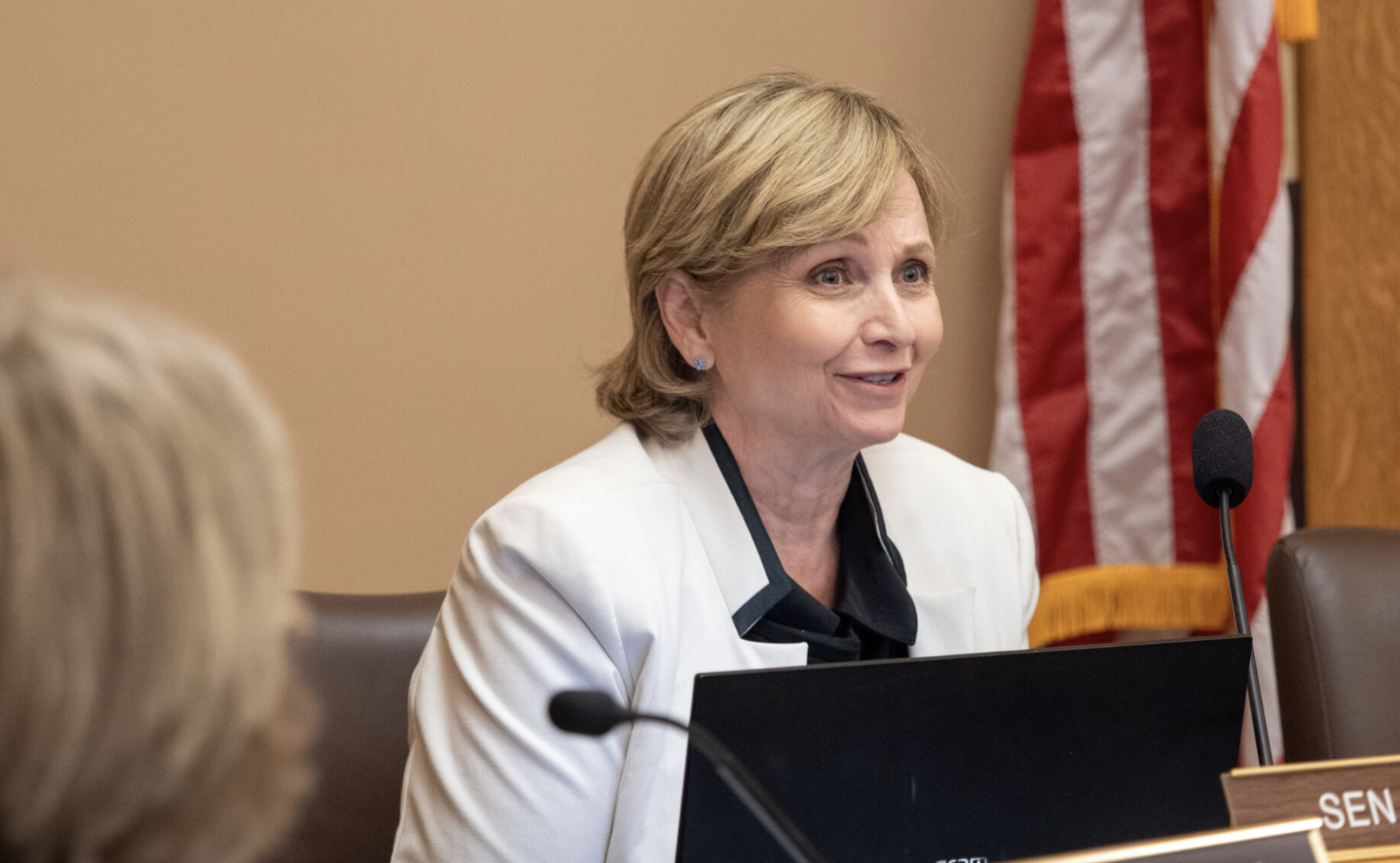
Sen. Caryn Tyson apologizes for misrepresenting amendment, opposes repeal
By: Tim Carpenter
Kansas Reflector
TOPEKA — Sen. Caryn Tyson, who labels herself “Tax Cutting Tyson,” successfully pitched to fellow senators a budget amendment creating a state revenue lockbox dedicated to reducing the property tax mill levy supporting K-12 public schools.
No one in the Kansas Senate inquired about details of her amendment, which was quickly approved last week amid debate on two dozen ideas for tweaking Senate Bill 315. The special account would allow the Legislature to chip away at the 20-mill annual property tax for schools, she said.
“We’re going to establish a property tax relief fund,” said Tyson, a Parker Republican who chairs the Senate’s tax committee. “There’s no money in it. So, there’s no fiscal cost.”
The Senate agreed without objection to drop her proposal into the bill.
That’s the way things stood for 2½ hours until Sen. Stephen Owens, R-Hesston, surprised senators with his discovery that Tyson’s amendment earmarked millions of dollars in online state lottery revenue for the new property tax fund. Tyson’s amendment actually reappropriated lottery revenue that was promised for care of mentally ill adults and people with intellectual and developmental disabilities, as well as the frail and elderly population.
“We often hear in here there’s no such thing as a simple bill,” Owens said. “Well, it turns out there is no such thing as a simple amendment.”
Oops, wrong amendment
Owens said he regretted not pressing Tyson for details of the amendment embedding a property tax relief fund in the state budget. He blamed his passivity on an inherent trust in a legislative process obligating lawmakers to present accurate information about proposed amendments.
Unbeknownst to senators when they voted to pass Tyson’s amendment, the measure required all state iLottery proceeds above $80 million per year to be deposited in the special fund to replace property taxes collected to fund schools.
“I do think we need to have an open and transparent discussion about where those funds are coming from and where they’re being redirected,” Owens said.
Throughout Owens’ remarks, Tyson stood at her desk on the Senate floor waiting to speak. She apologized in her speech for failing to accurately describe the amendment that had won Senate approval.
“I would never try to mislead this body — ever,” Tyson said. “I grabbed the wrong amendment. I thought that I had the amendment that was only going to establish the property tax relief fund.”
Tyson said she inadvertently presented the Senate with a more ambitious amendment that withdrew millions of dollars from safety net programs. She said her intent was to merely create an account for property tax buydowns. She planned to propose later in the legislative session a series of amendments that transferred state dollars, including iLottery revenue, to the fund for property tax relief.
She said another idea for generating cash for property tax relief would be a new state tax on production of renewable energy, such as wind or solar.
“We’re actually going to have a tax trailer bill, if you will, that would compel the buydown,” Tyson said.
‘Good intentions’
Sen. Rick Billinger, a Goodland Republican and chairman of the Senate Ways and Means Committee, said he opposed Tyson’s proposal to alter appropriations of iLottery revenue.
He said the first $8 million above the $80 million iLottery baseline would support a voluntary network of support for adults with serious mental illness. He said the Senate bill would free up $10 million to reserve 240 beds at six hospitals for patients with mental disorders.
In addition, Billinger said, the bill depended on iLottery dollars to help people with disabilities land jobs. The bill set aside cash to provide in-home care for frail or elderly people so they had a greater chance of avoiding placement in a nursing home, he said.
“What we were trying to do here was use the excess lottery (for) good intentions,” Billinger said.
Tyson responded to Billinger by arguing against Owens’ bid to repeal the amendment she had submitted in error. Tyson said the Legislature should take the unexpected opportunity to begin building the property tax fund. She said every $45 million set aside in the account could eliminate 1 mill of the state property tax for schools.
“It’s these feel-good funds that were just talked about versus actual property tax relief to buy down the 20 mill. This is real relief for your constituents,” Tyson said.
The Senate passed Owens’ motion to strike Tyson’s amendment from the bill. He said taking iLottery revenue from Kansans reliant on safety net programs wasn’t the way to address property taxes.
“From my perspective, I would not balance the budget or reduce property taxes on their backs,” Owens said.
Before the Senate completed work on the budget bill, Tyson proposed and the Senate accepted an amendment that merely established the property tax fund.